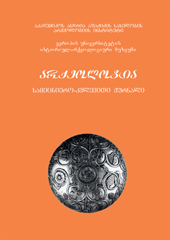
A HOARD OF KUFIC COINS FROM SAGAREJO SILK ROAD ISSUES IN LIGHT OF NUMISMATIC MATERIAL
Keywords:
Silk Road, numismatics, hoard, coin, dirhamAbstract
The article concerns a hoard of Arabic dirhams found in a clay jar near the town of Sagare
jo in 2017, and its examination within the historical and numismatic context of the Silk Road.
The study discusses at length the formation of the transcontinental Silk Road trade network,
its routes, and the role of cultural and economic relations between civilizations; the strategic
position of Georgia (particularly of Mtskheta and Tbilisi) within this system; and, from the sixth
century onwards, the Byzantine–Iranian commercial rivalry and the emergence of alternative
northern routes across the Caucasus, established by the Sogdians. Separate attention is given
to the phenomenon of silver hoards of Scandinavian origin, the connections between the Vi
king-Varangians and Georgia, in particular their participation in the historical episode of the
conflict between Bagrat IV and Liparit Baghvashi, as well as to interesting parallels with Geor
gian coins (of the Jafarids and of David III Kuropalates) found in Tbilisi and in Europe. The core
of the article is a detailed description of the 115 coins in the Sagarejo hoard: their chronology
(80-189 AH, i.e. 699-805 CE); the mints, which range from north-western Africa to western Iran
(Madinat al-Salam, al-Muhammadiya, al-‘Abbasiya, al-Basra, al-Andalus, and others); and the
probable date of deposition, linked to the turmoil that began after the death of Caliph Harun
al-Rashid. The concluding section suggests that this hoard, together with other similar regional
finds, attests to Georgia’s deep and long-standing involvement in the international trade and
cultural network of the Silk Road in the Early Middle Ages.